- [Case Studies](/category/case-studies)
- [eCommerce tips](/category/ecommerce-tips)
- [Online Store Solutions and Platforms](/category/online-store-solutions-and-platforms)
- [Mergado Pack](/category/mergado-pack)
- [Mergado tips](/category/mergado-tips)
- [Mergado News](/category/mergado-news)
- [eCommerce News](/category/ecommerce-news)
- [How to use Mergado](/category/how-to-use-mergado)
- [Interviews with e‑commerce gurus](/category/interviews-e-commerce-gurus)
- [Extensions](/category/apps-bidding-image-marketing-and-more)
- [Expansion with Mergado](/category/expansion-with-mergado)
- [Mergado Lifestyle](/category/mergado-lifestyle)
1. [ Home ](/)
2. [ Mergado Blog ](/blog)
3. [ How to use Mergado ](/category/how-to-use-mergado)
4. **Learn all data regeneration options to speed up changes in Mergado**
# **Learn all data regeneration options to speed up changes in Mergado**
[  Lukáš Horák ](/blog/lukas-horak) [How to use Mergado](/category/how-to-use-mergado)
16. 4. 2020
3 minutes read

With [Mergado](https://www.mergado.com/get-started), you can quickly get an **overview** of the changes you’ve made. Your edits appear after data has been regenerated. Data regeneration has **several** **options**. Let’s describe where you can use its particular types.
function tableOfContents() {
return {
headings_menu: [],
heading_active: '', // Added to track the active section
shouldBeSticky: false,
generateToC() {
const headings = document.querySelectorAll('.js-article-full-headings h2, .js-article-full-headings h3');
let headingMap = {};
headings.forEach((heading) => { // Use an arrow function to maintain `this` context
// Normalize heading text to remove diacritics, then replace non-alphanumeric characters with dashes
var normalizedText = heading.textContent.normalize("NFD").replace(/[\u0300-\u036f]/g, ""); // Remove diacritics
var id = heading.id ? heading.id : normalizedText.trim().toLowerCase()
.split(' ').join('-').replace(/[^a-z0-9\-]/ig, ''); // Updated regex to replace non-alphanumeric characters
headingMap[id] = headingMap[id] !== undefined ? ++headingMap[id] : 0;
// Use the updated `id` with diacritics removed for the heading id and the TOC
const finalId = headingMap[id] ? `${id}-${headingMap[id]}` : id;
this.headings_menu.push({
id: finalId,
title: heading.textContent,
level: heading.tagName.toLowerCase(), // Track heading level
active: false, // Initially set active to false
});
heading.id = finalId;
});
},
checkStickyNeeded() {
const ul = this.$el.querySelector('ul');
if (ul) {
this.shouldBeSticky = ul.scrollHeight < window.innerHeight;
}
},
setActiveHeading() {
// disabled not working with active state on click
// add @scroll.window="setActiveHeading()" to the parent div
// const headings = document.querySelectorAll('.js-article-full-headings h2');
// let activeHeading = '';
// let closestHeadingDistance = Infinity;
// headings.forEach((heading) => {
// const rect = heading.getBoundingClientRect();
// const offset = rect.top - window.innerHeight / 2; // Consider heading in the middle of the screen as active
// if (offset < 0 && Math.abs(offset) < closestHeadingDistance) {
// activeHeading = heading.id;
// closestHeadingDistance = Math.abs(offset);
// }
// });
// // Update the active state in headings_menu
// if (activeHeading !== this.heading_active) {
// this.headings_menu = this.headings_menu.map(item => ({
// ...item,
// active: item.id === activeHeading,
// }));
// this.heading_active = activeHeading;
// }
},
setActiveItem(clickedId) {
this.headings_menu.forEach(item => {
item.active = (item.id === clickedId);
});
this.heading_active = clickedId; // Optionally update the heading_active property if used
},
};
}
1. —
With [Mergado](https://www.mergado.com/get-started), you can quickly get an **overview** of the changes you’ve made. Your edits appear after data has been regenerated. Data regeneration has **several** **options**. Let’s describe where you can use its particular types.
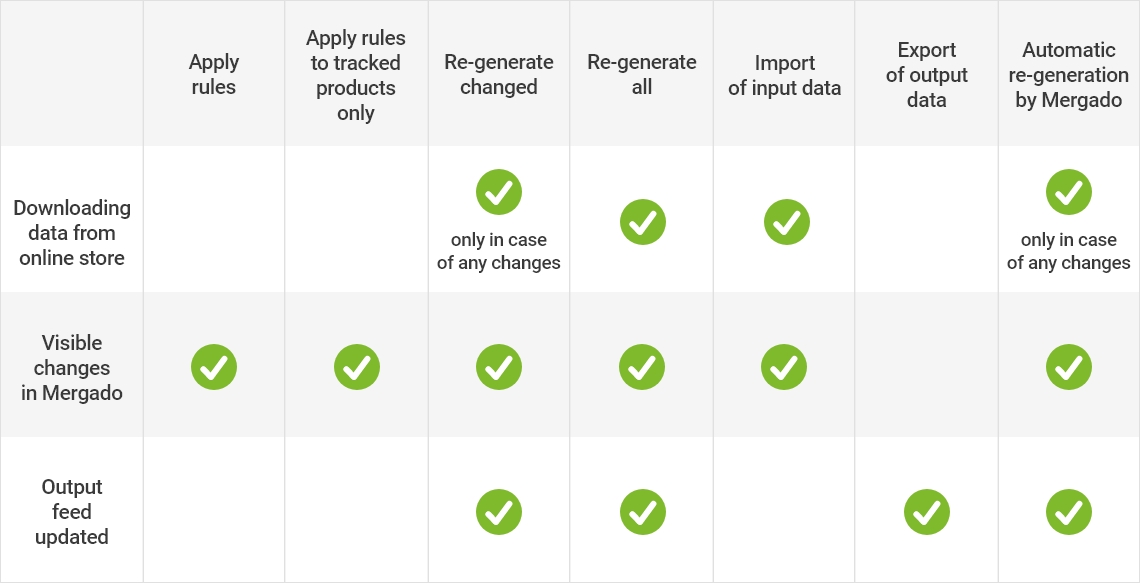
## What types of data regeneration you can use in Mergado?
- ### 1. Applying rules
- After applying the [rules](https://www.mergado.com/tag/rules-in-mergado), the changes will **only be reflected in Mergado**.
- **New** **data** from a store is **not** **loaded** in this case.
- The output feed is **not** **updated** as well.
- It is useful for **checking added rules**.

##### *The Apply Rules button on the Rules page in Mergado.*
- ### 2. Applying rules only to monitored products
- This is **the fastest way** to regenerate data in Mergado.
- It is **described** in [Work faster with Mergado](https://www.mergado.com/blog/work-faster-with-mergado) article.
- Here apply the same conditions as in point 1, but it is significantly **faster** because the operation is done only to the monitored products.
- It is used as a “diagnostic tool” to determine how specific **rules change the value** of the elements of a given product.

##### *How to turn on product tracing on the Products page in Mergado.*

##### *Apply the rules only to the monitored products.*
- ### 3. Regeneration of changed data
- Mergado **retrieves** new data from a store, then applies the rules, but ONLY to the products changed since the last regeneration, then exports the data to the output feed.
- It is useful when you need to **display** **changes** to the output feed as quickly as possible, but at the same time do not want to apply rules to the entire feed.
- You can access it in the *Settings* -> *Regenerate* page.
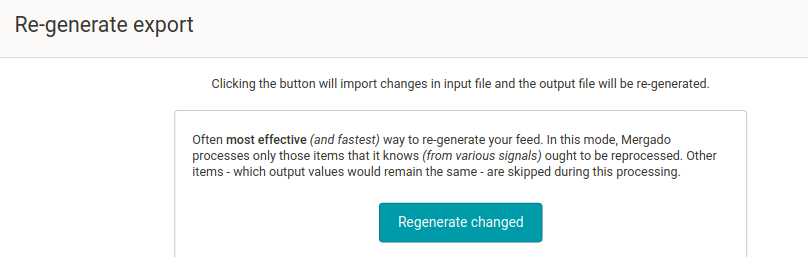
##### *The Regenerate button changed on the Regenerate page.*
- ### 4. Regeneration of all
- With this additional option on the *Settings* tab, Mergado **reads** new data from a store, **applies** the rules to all products, and **exports** the data to the output feed.
- It is useful if you want to make changes to the output feed as quickly as possible, or if you need to force an update for the products that have not been changed since the last regeneration.
- You can access it in the *Settings* -> *Regenerate* page.
- It is usually used **after** **editing** (using rules, queries, etc.) in Mergado to get all changes to the output feed as soon as possible.
##### 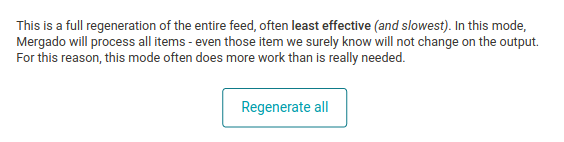
##### *The Regenerate all button on the Regenerate page.*
- ### 5. Input data import
- It retrieves data from the input [URL](https://www.mergado.com/tag/url-in-xml-feed) and imports changes to Mergado.
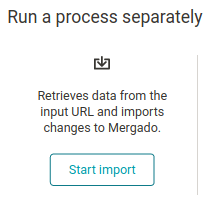
##### *The Input data import button on the Regenerate page.*
- ### 6. Output data export
- It exports the resulting items from Mergado to an output file.
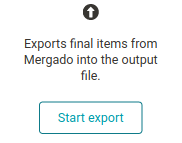
##### *The Export data button on the Regenerate page.*
- ### 7. Automatic regeneration by Mergado
- It runs continuously **on** **its** **own** and functionally corresponds to the regeneration of changed products (see point 3 above).
- It **can** **be** **paused** to prevent an “unwanted” update of the output feed when the rules are being edited in Mergado.
- All information on automatic regeneration can be found in the article [Mergado FAQ: Automatic data regeneration](https://www.mergado.com/faq-data-regeneration).

##### *The Pause regeneration button on the Regenerate page.*

##### *The Enable regeneration button below on the Regenerate page.*
[  ](https://www.mergado.com/sites/default/files/perm/paragraph-image/moznostipregenerovanidaten.jpg)

### What affects the speed of data regeneration in Mergado?
1. The most time-consuming is **processing** **rules** of [apps](https://www.mergado.com/category/apps-for-bidding-image-marketing-and-more) from the Mergado Store because they are linked to Mergado via API. Communication is technically more difficult.
2. The rate of regeneration is also affected by the **number of products** in the [feed](https://www.mergado.com/tag/xml-feed). You can avoid this by applying rules to traced products only.
3. As a user, you can affect the length of data regeneration if you [set up Mergado efficiently](https://www.mergado.com/queries-to-input-values).
Pay attention to when and how you regenerate data. This can speed up the display of feed changes, giving you valuable extra minutes when you set up your advertising.
### **You could be interested in:**
[ 
### What should a proper client context look like for performance specialists?
](/blog/master-prompt-eshopy-b2c)
[ 
### How Feed Optimization Unlocked Meta Ads Performance without Increasing Ad Spend
](/blog/feed-optimization-for-meta-ads)
[ 
### How to Sell Successfully on idealo
](/blog/successful-sale-on-idealo)
[  ](/blog/lukas-horak)### [ Lukáš Horák ](/blog/lukas-horak)
Lukáš takes care of most of the Czech and English communication in Mergado. Through blogs, e‑mail, and social networks, he regularly supplies readers with e‑commerce news and news and tips from Mergado. In his time off, he enjoys simple things like badminton, digging the hidden gems of the 80’s, and seafood served with red wine.
## What you *might be interested in next*
[ 
### How We Migrated an E‑Shop from Shoptet to Shopify with Mergado: A Complete Migration Without Data Loss
](/blog/how-we-migrated-e-shop-shoptet-shopify-mergado-complete-migration-without-data-loss)
[ 
### How to open large XML file
](/blog/how-to-open-large-xml-file)
[ 
### Introducing smart value insertion. It will speed up the creation of bulk rules
](/blog/smart-value-insertion)
## Don’t miss *anything*
Sign up for our newsletter
By logging in, you agree that we will process your data by the [terms of personal data protection](/cookies).
Thank you, you have successfully joined our subscriber's list.
function ml_webform_success_5807248() {
var r = ml_jQuery || jQuery
r('.ml-subscribe-form-5807248 .row-success').show(), r('.ml-subscribe-form-5807248 .row-form').hide()
}