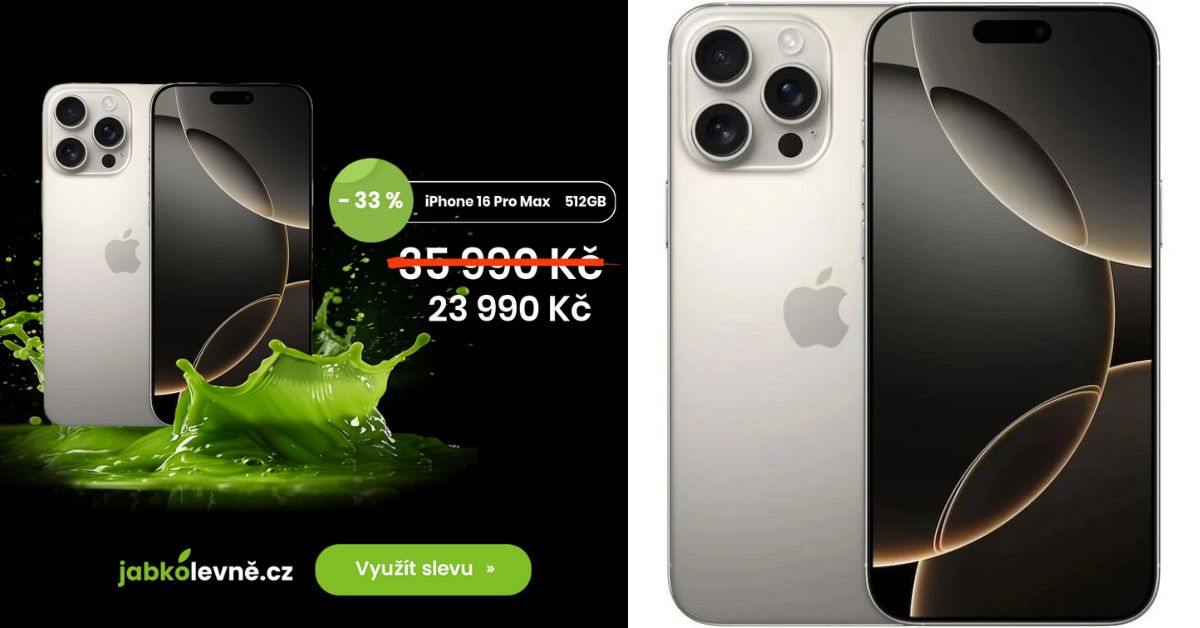





Dynamic Ads
These ads perform extremely well in the middle and lower stages of the marketing funnel, but they come with one major drawback. If you sell products that are identical to those of your competitors, there is little room for creative differentiation. Yes, you can use a dynamic frame, but it is displayed only to a limited extent and only in certain placements.
That is why at the Effectix agency we have long been using the external tool Feed Image Editor by Mergado to dynamically optimize product images. This allows us to enhance product images with brand colors, add a logo and CTA, price, discount, or a promotional claim.
Until now, however, we had never tested the real impact of this tool. That has now changed.
Business Model
The test was launched on the JabkoLevně online store.
This is an online store focused on selling used electronics, especially Apple phones, tablets, and computers. The product portfolio is dominated by higher-priced items.
The typical customer is someone who wants a premium product while also preferring a more economically and environmentally friendly alternative to buying a new device. The online store therefore combines a performance-driven offering with an emphasis on trustworthiness, expertise, and long-term customer satisfaction.
A/B Test Setup
An A/B test ran over a five-day period, in which two identical ad sets were tested against each other. They had the same settings, the same budget and schedule, identical ad formats, and copy. We also paid close attention to Advantage+ creative settings. Both ad sets used the same product groups and the same formats (catalog carousel and catalog single image ad).
The only difference was that the first ad set (set A) used a catalog in which product images were modified using the above-mentioned external tool, while the second ad set (set B) used a catalog with the original, unedited images. To ensure the quality of the test, both catalogs were connected to the same dataset and had been collecting data for more than 90 days prior to the test. In other words, aside from the product images, set A was identical to set B.