In this article, we summarize what OpenAI Ads is, how it works, what testing phase it’s currently in, what campaign management looks like, and how Mergado can help you connect to it. Finally, we’ll take a look at where the whole system is likely headed.
What Is OpenAI Ads
OpenAI Ads consists of paid advertisements displayed directly within ChatGPT’s responses. The ad appears at the end of a text response, is clearly labeled as sponsored, and is visually separated from the assistant’s actual answer.
Central to the credibility of the whole system is OpenAI’s claim that ads have no influence on the content of responses. The ad system runs on infrastructure separate from the language model, and advertisers have no influence over how, when, or what ChatGPT tells the user. The ad is only “added” to the response — it doesn’t interfere with it. At the same time, users’ conversations remain private from advertisers. OpenAI neither shares nor sells that content to them.
Ads also don’t affect all users. They appear only on the Free and Go plans. The paid tiers — Plus, Pro, Business, Enterprise, and Education — remain completely ad-free. OpenAI also states that ads are not shown to accounts identified as belonging to users under 18.
How the Ad System Works
Targeting by Context, Not by Keywords
Unlike classic search PPC, OpenAI Ads doesn’t work with exact keyword matching. At the ad group level, advertisers provide so-called contextual signals — descriptions of topics, conversations, or products where their ad might be relevant. The system then decides whether to show an ad based on broader context: the content and intent of the current conversation, the ad’s landing page, its headline and copy, and — if the user has ad personalization turned on — additional signals from their regular ChatGPT usage.
In other words, advertisers don’t specify exact keywords, but rather the context in which it makes sense for their ad to appear. The final decision on whether to display an ad always rests with OpenAI’s algorithm.
Auction Model and Purchase Options
OpenAI doesn’t select ads simply based on who bids the most. Relevance to the given conversation matters too, so a lower bid with high relevance can beat a higher but less relevant one.
Two basic purchase models are supported:
- CPM — cost per thousand impressions
- CPC — cost per click; OpenAI recommends a starting maximum bid of $3 – 5 per click
Bids are set at the ad group level.
Content Policies
Not every advertiser, and not every product, can advertise on ChatGPT. For example, advertisers from sensitive industries such as healthcare or weapons are not permitted to advertise. During the current testing period, ads are limited to a handful of categories: lifestyle and home goods, local services, travel and experiences, digital products, and education. The system also recognizes so-called “brand-unsafe” conversations — meaning that if an ad’s presence in a given conversation would seem inappropriate, OpenAI simply won’t show one there.
Testing Phase and Who Can Take Part
OpenAI Ads is still in the pilot-testing phase, not a broadly available product. The pilot launched in February 2026 in the US, for users on the Free and Go plans. In March, OpenAI announced that testing had so far had no negative impact on user trust, and in May it expanded beyond the US — to the United Kingdom, Canada, Australia, Mexico, Brazil, Japan, South Korea, and New Zealand.
In Ads Manager (the interface advertisers use to set up and manage campaigns), it’s important to distinguish between two separate things:
- Who a campaign can target (“Locations for this campaign”) — advertisers can currently choose from 40 countries, 31 of them in Europe (essentially the entire EU plus Norway, Iceland, Liechtenstein, and the United Kingdom).
- Who can open an account (“Billing address”) — account creation and billing-address setup are currently available for 9 countries (the US, United Kingdom, Canada, Australia, Brazil, Japan, South Korea, Mexico, and New Zealand).
Access to Ads Manager itself isn’t yet open to everyone. OpenAI has confirmed that it hasn’t fully launched the platform and is still gathering feedback from a testing subgroup of advertisers. Companies that want to advertise on ChatGPT can register at openai.com/advertisers and wait for access to open up in their country.
What Campaign Management Looks Like
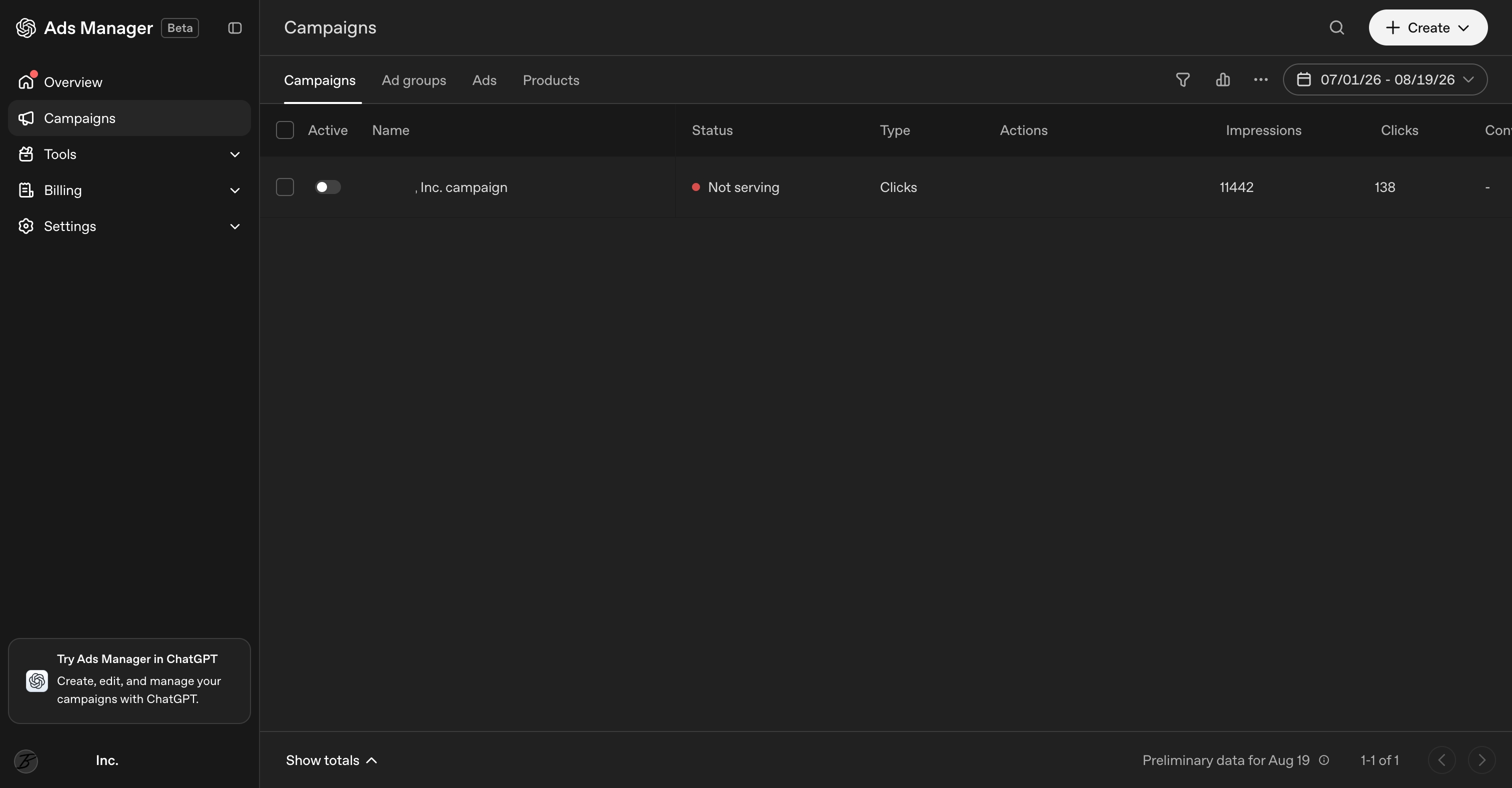
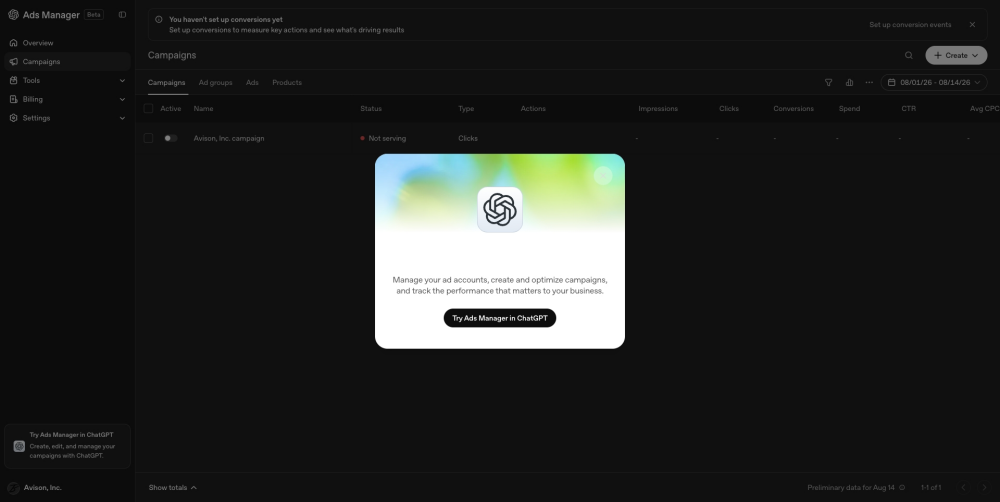
To manage ads, OpenAI offers Ads Manager — a platform for creating, launching, and managing campaigns, with performance-tracking tools all in one place. Thanks to our work with US clients and our own test account, we at Mergado also have access to Ads Manager. The interface’s layout resembles Google Ads.
Within Ads Manager, advertisers can:
- register as advertisers and enter billing details,
- set campaign budgets, bids, and spend pacing,
- bulk-upload ad creatives or build them directly in the tool,
- launch and edit campaigns,
- track performance and report results (impressions, clicks, spend, ROAS, CTR, CPC, CPM, conversions),
- view a change history that lets them trace back edits made to campaigns,
- use more advanced features, such as bulk campaign management via API or excluding locations from targeting.
Ads Manager is still in beta. It keeps evolving and is a live, fast-changing product. OpenAI rolls out new features gradually, account by account, so two advertisers may not see the same set of features at the same time.
Getting Your Product Catalog into the System
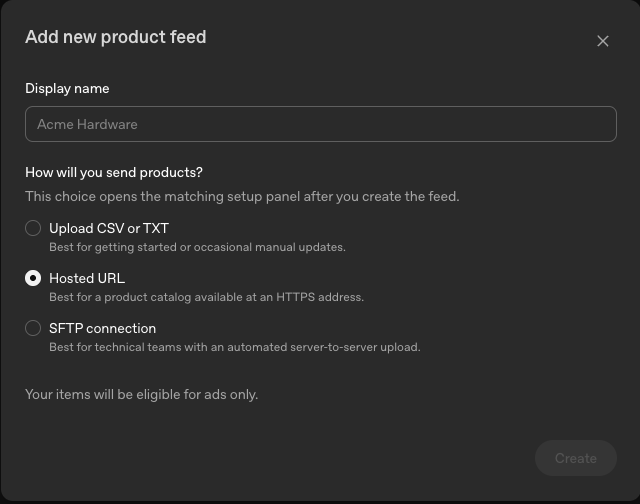
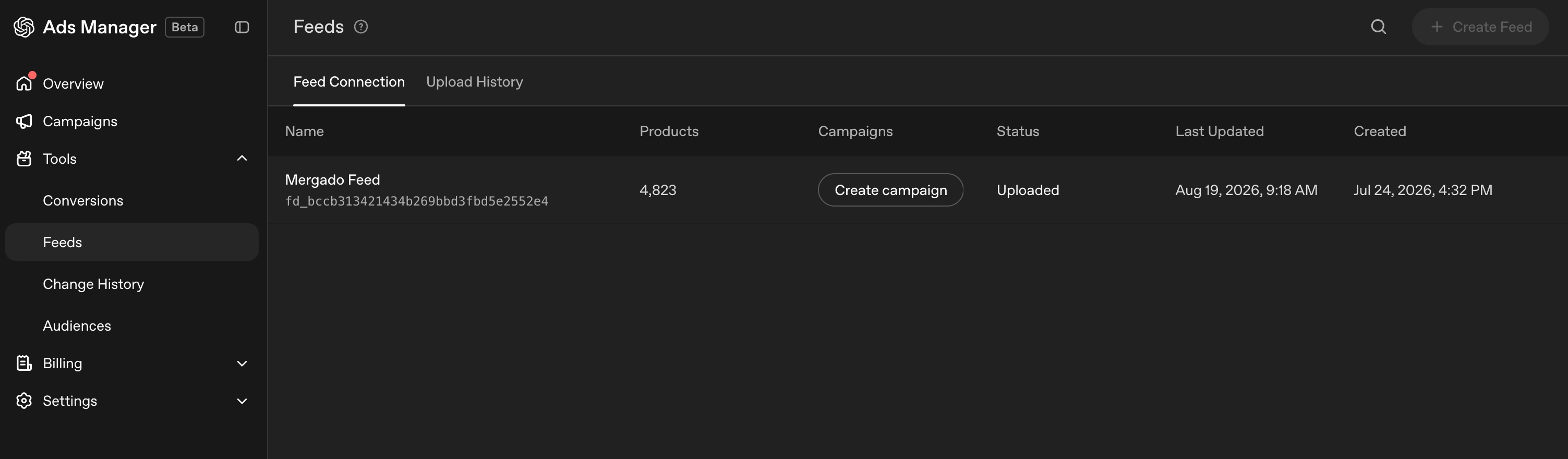
For advertisers, uploading a product catalog is a key part of setup. Ads Manager currently offers three ways to do it:
- upload a file (CSV or TXT) directly through the web interface
- provide a hosted URL where the catalog is available
- connect via SFTP for automated server-to-server uploads (this option also supports TSV and JSONL formats)
In every case, the feed must comply with OpenAI’s specification.
The campaign structure is conceptually the same as in Google Ads or Meta Ads: campaign → ad group → ad. Advertisers, however, don’t select keywords manually. The system itself matches individual products from the catalog to conversations based on user intent. Whether a specific product is allowed to appear as an ad is governed by the is_ads_eligible element (or label).
Required Elements Aren’t Enough — the Magic Is in the Conversational Attributes
The feed for ChatGPT Shopping has a fairly extensive specification — 75 elements in total. Most of them, however, aren’t required. When we tested converting an existing Google Shopping feed into the ChatGPT format, only 19 of these 75 elements were filled in, and OpenAI still approved the products without any problem.
That doesn’t mean the remaining elements don’t matter, though. On the contrary — it’s precisely the supplementary, so-called conversational attributes that determine how well and how often a product actually gets shown in ChatGPT, and how relevantly it’s presented. These attributes describe a product in a way that better matches how users ask about it and talk about it when conversing with ChatGPT. A feed that meets only the minimum requirements will still upload successfully and pass approval, but it strips products of a large part of their potential right at the moment a user is actually discussing them with ChatGPT.
The Relationship Between Paid Ads and Organic Product Listings
The Relationship Between Paid Ads and Organic Product Listings
An uploaded product catalog isn’t used only for paid ads. OpenAI also uses the same feed for organic product listings within ChatGPT’s responses and for checkout directly inside the conversation. What a specific product may be used for is governed by three separate elements (or labels):
- is_eligible_search — the product is eligible for organic listing,
- is_eligible_checkout — the product is eligible for completing a purchase directly in ChatGPT,
- is_ads_eligible — the product is eligible for paid advertising.
For newly accepted products, OpenAI enables search and disables checkout by default. So it isn’t a separate data source that distinguishes the paid part from the organic one — it’s the eligibility settings applied to the very same feed.
Managing Campaigns Directly in ChatGPT
Besides the web-based Ads Manager, OpenAI offers an official app (plugin) called ChatGPT Ads Manager, which lets you run the entire platform conversationally, directly inside ChatGPT. The app can create and manage ad accounts, campaigns, ad groups, and ads, evaluate performance and conversions, upload creatives, and in some cases even complete self-service account setup.
It has both read and write permissions, meaning it can genuinely change campaign settings — though you can optionally switch on an agent mode that only makes recommendations and doesn’t modify campaigns on its own. As with other new features, the app’s availability is being rolled out gradually, account by account, so not every advertiser can see it yet.
What This Means for Online Stores
For e‑commerce, OpenAI Ads is still a new, little-explored, but potentially highly relevant channel — for several reasons:
- ChatGPT is becoming a shopping advisor. People are increasingly asking ChatGPT not just for information, but directly what to buy, which product to choose, or which service to use. That’s exactly the moment when paid advertising makes sense — the user is in the comparison and decision-making stage, not just passively reading.
- It’s still an experiment, not a channel with a proven return on investment. Given the higher cost and the rules still in flux, it currently makes more sense to test OpenAI Ads with a smaller, separate budget aimed at validating the concept and building brand awareness, rather than as a replacement for established performance channels.
- Availability is still limited. Before an online store invests time in preparing campaigns, it needs to check whether its market and company size are even part of the currently open testing. Access keeps gradually expanding, and next week it’s set to reach Europe as well.
- Technical preparation is worth doing now, though. Connecting a product feed to OpenAI via SFTP can be set up in advance, even before the pilot opens in a given country — more on that below.
How Mergado Helps With Connecting to OpenAI Ads
Mergado supports exporting product feeds directly into the format OpenAI requires, including automatic, regular uploads via SFTP to OpenAI’s server. The connection to your SFTP/FTP server only needs to be set up once, in Mergado Keychain, and you can then use it for one or several projects at the same time. That removes the need to handle the technical side of the connection manually — Mergado generates the feed in the correct specification and takes care of delivering it on a regular basis.
You can also set up the connection to OpenAI’s SFTP server right when creating a project, whether in Canvas or in the old user interface (either by using an existing connection from Keychain or by creating a new one).
Although online stores from Czechia and Slovakia currently can’t open their own account in Ads Manager (billing support isn’t yet available for these countries), it’s worth setting up the connection through Mergado in advance. As soon as OpenAI opens billing for more European countries, you’ll be able to get started right away, without unnecessary delay.
Verified With Real Clients
We’ve verified the integration end-to-end with a real overseas online store that took part in the OpenAI Ads pilot. Results from our own testing:
- The ChatGPT Shopping format and Mergado’s SFTP connection work reliably — Mergado regularly sends the current feed to OpenAI’s server, and OpenAI sees and imports the changes made.
- Out of 4,868 products in total, 4,810 were successfully uploaded — the vast majority of the catalog.
- The main operational challenge remains the minimal feedback OpenAI Ads Manager provides on data quality. Errors and the reasons individual products fail to upload have to be tracked down by trial and error, without any specific explanation from the platform.
Looking Ahead
Several trends suggest where OpenAI Ads is likely headed:
- Beyond the classic “click → redirect to website” format, OpenAI is testing a fundamentally different concept: Agent-type campaigns. Instead of a click on the ad opening the advertiser’s landing page, it launches a live conversation with an automated AI agent for that company, generated automatically from the content of its website. This agent can discuss with the user what they’re looking for and steer them toward the right product or purchase — all directly within the chat, with no need to visit the website. This is a feature independent observers in the ad-tech industry have spotted; OpenAI hasn’t yet communicated details about it officially. It’s likely still in early testing, so it isn’t certain whether — or in what form — it will eventually roll out more broadly.
- Tighter integration of advertising and purchasing. Development is heading toward product discovery, decision-making, and purchasing all happening within a single conversational flow, with no need to leave ChatGPT.
- Gradual opening of additional markets. OpenAI has repeatedly signaled its intent to expand testing to more countries once it has enough data from the markets currently being tested.
- Accelerating product development. The pace at which OpenAI is adding new features to Ads Manager (bulk API, measurement integrations, new formats) points to an ambition to build a full-fledged, scalable advertising platform comparable to the major players in the market.
Summary
OpenAI Ads is still only at the beginning of its journey — the testing phase, limited availability, fluctuating numbers, and the still-high cost make that clear. At the same time, it’s a platform evolving unusually fast, heading toward linking advertising directly with the conversational shopping process — a concept established platforms don’t yet offer in the same form.
For online stores, that means just one thing: keep an eye on developments, check availability in your market, and, if it makes sense, set aside a small test budget to see how this new channel performs — without expecting an immediate return, but with an open mind about what it could deliver once OpenAI Ads becomes a full-fledged product.