Keywords Aren’t Enough Anymore
The classic product feed was built for a world where people searched using short keywords, like “men’s running shoes” or “24-inch dishwasher.” Search today looks different. In AI Mode, people ask much longer, more specific questions, like “running shoes for flat feet under $100 that won’t slip on wet surfaces.” A well-filled-out title and category simply won’t cut it for a query like that. Google needs far richer product context than standard feed elements can provide.
Conversational attributes are Google’s answer to that gap. They’re not meant to replace the classic elements (title, description, product_highlight, and so on), but to complement them. Google stresses that they’re entirely optional, and whether or not you fill them in has no bearing on whether your product gets approved in Merchant Center.
Six New Ways to Tell Google More
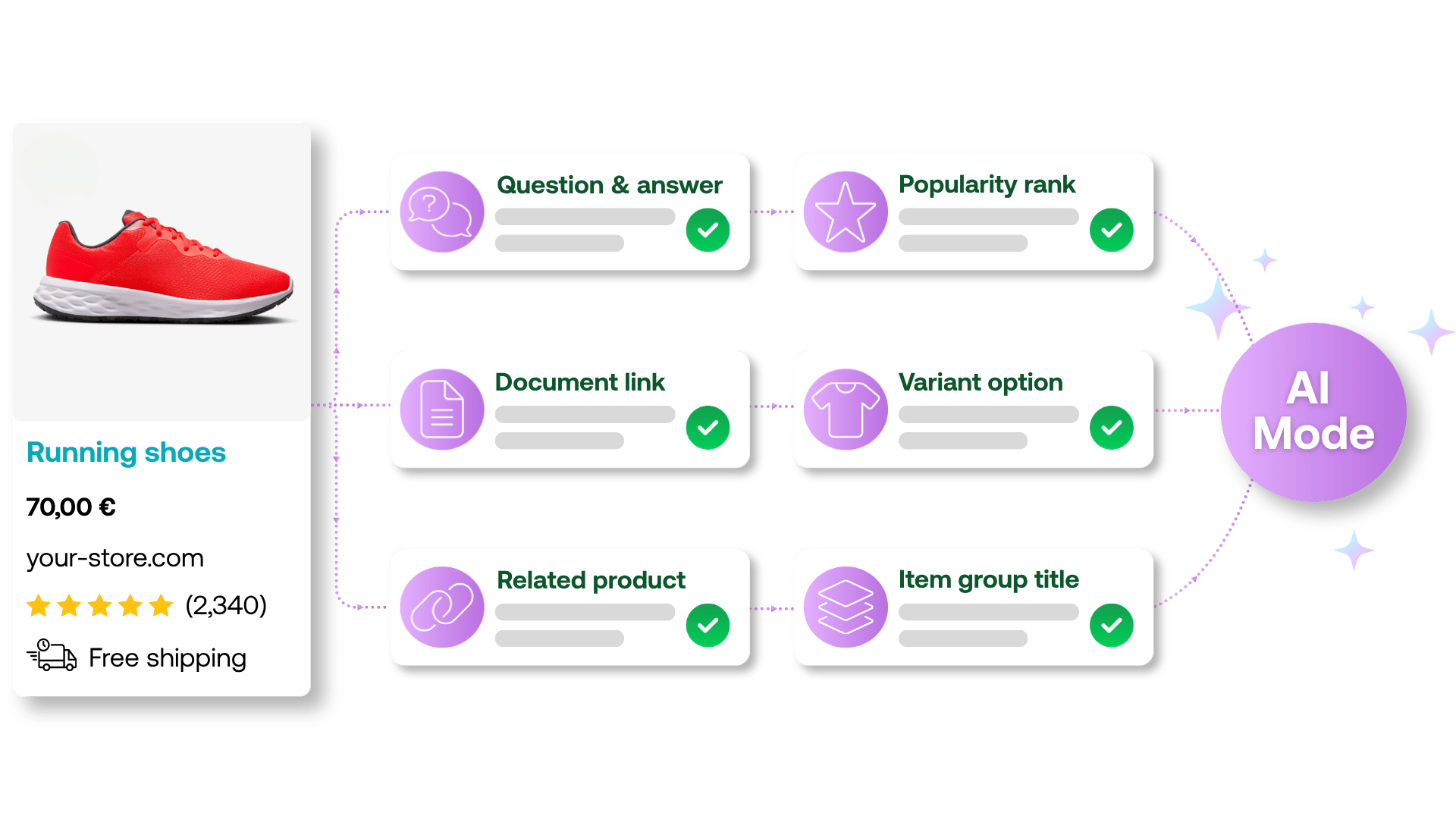
Here’s an overview of what the new elements include and what they’re for:
1️⃣ question_and_answer – a question/answer pair about the product. Google allows up to 30 pairs per product, with each question and answer allowed up to 1,000 characters. This is a good place for answers to questions like “Is this dishwasher-safe?” or “Does the package include a charger?”
2️⃣ document_link – a link to a supporting PDF document, such as a user manual or assembly instructions. You can include multiple links separated by commas.
3️⃣ related_product – defines a relationship between products. It consists of three parts:
- relationship type (relationship_type) – Google supports six values here:
- substitute – a comparable product that serves the same function
- accessory – an add-on for the product
- required_part – an essential component of the product
- often_bought_with – a product customers frequently buy alongside this one
- different_brand – the same or a similar product under a different brand
- part_of_set – a product from the same line or set that makes sense to offer together
- identification method (identifier_type) – id or gtin
- the identifier itself (identifier) – the identifier value
4️⃣ item_group_title – a shared name for a product with multiple variants, used together with item_group_id.
5️⃣ variant_option – describes what sets a specific variant apart from the others.
6️⃣ popularity_rank – expresses a product’s relative popularity as a percentage, where a higher number means a stronger position within your assortment.
Tell Google What the Product Is For, Not Just What Color It Is
You don’t need to fill in all six attributes across your entire catalog right away, and with a larger assortment that’s often not realistic anyway. The best place to start is with three of them, since there simply hasn’t been room in the feed for this kind of information until now.
💬 Question and answer (question_and_answer)
A specific answer to a specific question that customers genuinely have, but that a standard product description doesn’t cover. For example: “Will this jacket hold up in heavy rain all day, or is it more for light drizzle?” An answer like “Yes, the jacket is waterproof” won’t do AI much good. What’s actually useful is a concrete answer – for example, that the material holds up through a full day of steady rain, not just passing showers – something specific enough for AI to match the product correctly. Try thinking about what your customers ask most often.
🛍️ Related product (related_product)
This tells Google what goes with a product, what can replace it, or what else customers will need alongside it. When a customer asks “What do I need for cooking on a backcountry hike?”, AI needs to know how the items in your catalog relate to each other – for example, a camping stove, the matching gas canister, and a nesting cookware set. Without that link, AI can offer little more than the stove on its own, even though the customer is really after the whole setup.
📄 Document link (document_link)
This gives AI access to entire documents, not just a few sentences from a description. At first glance it might look like the least exciting of the bunch, but it’s actually one of the most valuable, and filling it in takes almost no effort. All you need is a URL pointing to the document; no rewriting or reformatting the content required. This covers material almost nobody actually reads: assembly instructions, lab test results, or manufacturer documents. That lets Google answer even a detailed question like “What tools will I need to assemble this bookshelf?” without having to guess from a short description. And since suppliers and online stores typically don’t publish this kind of content anywhere else, there’s a good chance you’ll be among the first to make information this specific available to AI at all.
How to Send Attributes to Merchant Center
Google offers two ways to do this:
- Supplemental feed – the recommended option. You upload a separate TSV, XML, or Google Sheet file, which links to your primary feed via a matching product ID (offer_id). The advantage is that you don’t have to touch the structure of your main feed, and you can start small, for example, just with your bestsellers.
- Adding attributes directly to the primary feed (or via the Merchant API). Mergado supports this method too. The elements for conversational attributes are already available in the Mergado Editor, and you can fill them in the standard way, using rules.
Since these are optional fields, a badly formatted value won’t cost you product approval, Google simply ignores it. That makes conversational attributes a safe space for gradual testing.
What to Watch Out for When Filling These In
Before diving into a blanket rollout, it’s worth thinking through a few things:
⚠️ Don’t start from scratch. You probably already have an FAQ section, technical specs, or manuals and assembly instructions somewhere on your online store. Reusing data that already exists is the cheapest way to enrich your product data, you just need to get it into the right format, not invent it from scratch.
⚠️ Quality over quantity. A field that just repeats what’s already in the description won’t tell Google anything new. What matters is genuinely additional information.
⚠️ popularity_rank needs upkeep. It’s a relative ranking across your catalog. Set it once and forget about it, and as your assortment and sales shift, it’ll stop reflecting reality, potentially feeding Google misleading information.
⚠️ With dozens or hundreds of products, filling this in by hand isn’t realistic. That’s where automation comes in, and Mergado can help.
How Mergado Can Help with Conversational Attributes
Rolling out six new fields across an entire catalog by hand would mean weeks of work for larger online stores. Mergado offers several ways to make that job dramatically easier, from populating the attributes to auto-generating content with AI.
Filling in Attributes in the Mergado Editor
The Mergado Editor supports conversational attributes as standard Google feed elements. You’ll find them already set up, no special configuration needed. Since these are entirely new types of data that you likely don’t already have in your source feed, we don’t recommend trying to piece them together from existing fields using rules. Instead, we recommend this approach: prepare the content outside of Mergado in a CSV file, then use that file to import it directly into the ready-made elements in Mergado. You can build that file from contextual product data, and your favorite AI tool can, of course, help you put it together.
Automatically Finding Substitute Products (related_product) in Feed Image Editor
One of the most interesting, but also most time-consuming, attributes to fill in is related_product with the value substitute, that is, identifying which of your products can stand in for one another. Manually matching up dozens or hundreds of items would be endless.
The Feed Image Editor (Mergado Editor extension) solves this with its visual similarity feature. AI compares product images across your entire feed and finds the most visually similar items in your assortment for each listing. The identifiers of similar products are then written into a new feed element, which you can map into the related_product structure (with relationship_type set to substitute) using the Bulk Copy Values rule in the Mergado Editor.
Auto-Generating Q&A and Product Highlights with Mergado Pilot
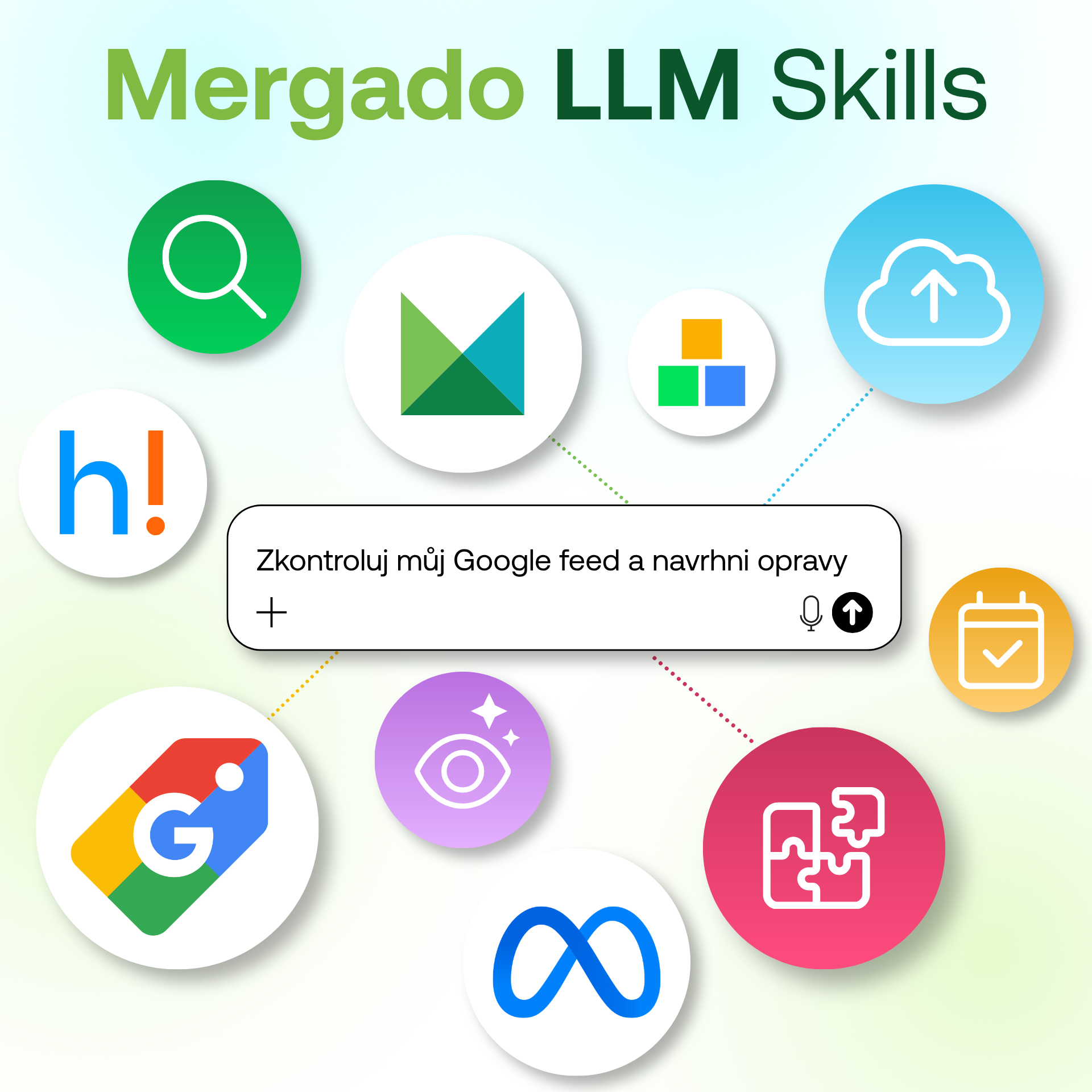
The question_and_answer attribute is, without a doubt, the most labor-intensive attribute to fill in. Manually writing out dozens of question/answer pairs for every product takes time most online store owners simply don’t have. That’s exactly what Mergado Pilot is for, a set of AI rules available in the canvas (the new Mergado Editor interface), where you’ll find it alongside the regular rules.
Mergado Pilot currently offers three types of rules, of which the following are especially relevant for conversational attributes:
- Q&A (question and answer) – automatically generates question/answer pairs directly into the question_and_answer element, for both Google Shopping and ChatGPT Shopping. The primary data source is the product description in your feed.
- Product highlight – generates key product features into the product_highlight element. While this isn’t technically one of the six conversational attributes in the strict sense, it belongs to the same family of “AI-ready” data. As with the other attributes, if you already have the same information elsewhere in your feed, there’s no need to duplicate it in product_highlight.
You’ll find details on these rules and how to configure them in the article Rule: Mergado Pilot in our help center.
Conversational Attributes Won’t Fix a Weak Feed
Don’t expect overnight results after adding these attributes, give it at least 3 to 4 weeks before it shows up in the data. Then check performance in Merchant Center for the products you’ve updated: what matters most is impression counts and which search queries the products are showing up for. If they start appearing for new types of queries you haven’t seen before, the attributes are working.
If nothing changes for your best-selling products even after a month, the problem is probably not the conversational attributes themselves, but a level below, how well you’ve handled the basic elements in your main product feed. Conversational attributes are an add-on, not a fix. If core elements like title or description are weak, that’s what’s worth checking first.
A Feed That Can Answer Back
More and more, people ask Google the way they’d ask a salesperson in a brick-and-mortar store, in full sentences, with context, with a specific need in mind. If your feed can’t answer that kind of question, AI simply won’t show your products. And this isn’t some distant future scenario. As AI search becomes more and more common, the cost of missing product context in your data keeps rising too. Conversational attributes may be optional, but empty fields still mean a missed chance to show AI systems exactly what your products offer, and why a customer should choose them.